
Elmina, 6:04 a.m. Mr. Biney, thirty‑four, a site engineer from Tarkwa, had checked in at eleven the night before after nine hours on a dusty road. He had a presentation at eight at UCC and needed only one thing before leaving: to shave and wash.
He turned the tap. Cold.
He called reception. No answer. The night auditor was escorting a drunk guest back to his room.
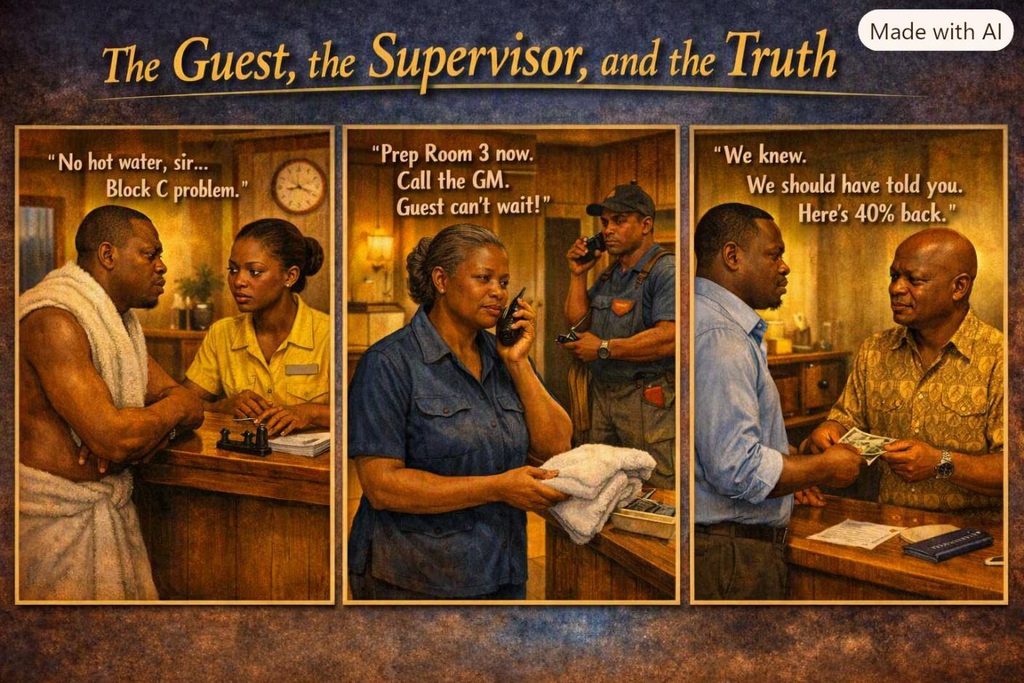
Mr. Biney came downstairs in a towel, angry. “My room water is cold. I need hot water to shave now.”
Selina, the morning front desk officer, was not rude. She was tired and honest. “Sir, I know. Block C has no hot water”, hesitating, “since yesterday. The solar pump failed. We reported it. Maintenance said they will fix it today.”
Mr. Biney stared at her. “So, you knew yesterday and still sold me Block C? Why didn’t you tell me at check‑in?”
Selina went quiet. She had been instructed not to mention the water issue unless a guest complained. The hotel was full.
Grace, the housekeeping supervisor, was cleaning the corridor. She understood that a bucket of hot water would not help a man who needed to shave and leave for a meeting. She did two unpopular things.
First, she broke the allocation rule. She checked the system and saw that Room 3 in Block A was vacant dirty from a six‑a.m. checkout, but its hot water was working. She turned to Mr. Biney. “Sir, give me seven minutes. I will prep Room 3 for you to shower and shave only. Your luggage can remain in Block C.”
Second, she escalated up, not down. She radioed maintenance. “Kofi, don’t tell me today. Tell me what time today? Guest has a meeting at eight.” Kofi replied that the parts were in Cape Coast, maybe eleven. Grace then called the GM at six‑fifteen, a call most staff are afraid to make.
Mr. Biney showered in Room 3. He was still angry, but clean. He did not say thank you. He said, “This is unprofessional,” and left for his presentation.
The GM did not offer a voucher at checkout. He met Mr. Biney and chose honesty over hospitality script. “Mr. Biney, you are right. We knew and we did not warn you at check‑in because we were full. That was wrong. I will not give you a free stay because you will not come back anyway. But I will refund forty percent of last night and send you the maintenance report by noon. We have ordered a backup heater.”
Mr. Biney left a two‑star review — brief, honest, and fair: “Water cold, but supervisor tried.”
It was not a glowing endorsement, but it was a mirror. The hotel saw itself clearly for the first time — not through praise, but through effort acknowledged. The water was cold at six‑oh‑four; the review was still cold at nine. Yet something warmer had begun: a culture that stopped lying by silence.
The hotel stopped selling Block C until the solar pump was fixed. A new rule was added to the night handover sheet: if a facility fails, note it at check‑in and offer an alternative before the guest discovers it.
Grace was not given a new title. She was given a specific morning authority: for ten minutes between six and seven, she could move any guest to a vacant dirty room with working water for bathing without asking Front Office permission.
The water was cold at six‑oh‑four. The review was still cold at nine. But the hotel finally stopped lying by silence.
And that is the Fifth Key here — that silence is not professionalism. It is avoidance dressed as calm. Hospitality is not the art of pretending everything works; it is the courage to admit when it doesn’t and to act before the guest loses faith.
The Fifth Key Lessons
1. Silence is not professionalism: Choosing not to disclose a facility failure at check‑in is avoidance disguised as calm. Guests feel betrayed when they discover problems themselves.
2. Transparency builds trust, even in failure: Grace’s intervention and the GM’s honesty at checkout showed that admitting the truth is more dignified than hiding behind scripts or excuses.
3. Empowerment matters: Giving Grace authority to act quickly — moving guests to a vacant dirty room for bathing — turned a rigid system into responsive service. Small permissions prevent big frustrations.
4. Escalation is courage: Grace’s decision to call the GM at 6:15 a.m. broke the culture of fear. Staff must know that protecting the guest experience is more important than protecting hierarchy.
5. Refunds are not the only recovery: The GM’s partial refund paired with a maintenance report was more meaningful than a voucher. It showed accountability and a plan, not just compensation.
6. Operational discipline prevents repeat failure: The new rule — noting facility failures at check‑in and offering alternatives — transformed a one‑time crisis into a lasting practice.
Disclaimer
The Fifth Key is a fictionalized case study. While inspired by real challenges in Ghanaian hospitality, the characters, properties, and scenarios are imagined. Any resemblance to actual people or establishments is coincidental. The purpose is to share operational lessons through storytelling, not to name, shame, or critique any individual or business.