
By 8:00a.m. the dining room was full — families, church groups, two school teams in blue track jerseys. Outside, the board promised: “Buffet Breakfast: 7:00 a.m. – 9:30 a.m.”
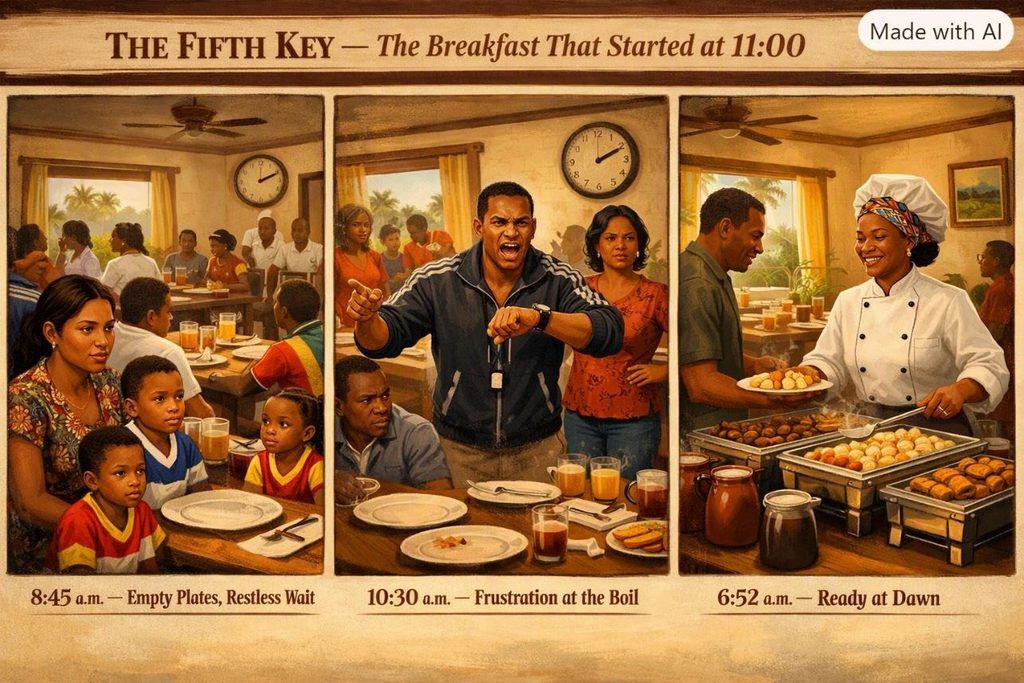
Inside, the tables were set with plates, forks, juice jugs. But no food. No eggs. No bread. No tea.
A mother with three children asked a steward close to her quietly, “Sister, when is food coming?”
“We are arranging, madam. It will come,” the steward smiled.
By 8:15, children were climbing on chairs. By 8:25, a coach grew restless. “We have a race at 9:30. They need energy now.” By 8:30, a guest stood up. “So, we are paying to watch plates?”
At 9:30, still nothing. At 10:00, still nothing. By 10:45, guests were furious.
At 11:00, the trolleys finally rolled in — hot eggs, sausages, porridge, bread. Guests did not clap. They stared. Then that quiet, tired laugh went round the room. Not joy. Not anger anymore. That Ghanaian laugh that means, ‘We have been fooled, and we know it.’
For guests, breakfast is a promise with a clock. If you sell 7:00, 7:00 must be edible. The kitchen thought, “Food is hot now, so we are fine.”
The guests thought, “We waited three hours to eat in thirty minutes.” Tomorrow’s reviews would not say, “Eggs were salty.” They would say, “Breakfast is a joke. Don’t book with children.”
At 11:05, F&B Manager Chef Dela walked in. She saw the faces and did not hide in the kitchen. She did three things, fast.
First, she owned the hours. She took the mic. “Good morning. We failed your time. Breakfast should have been ready at 7:00. It was not. I am sorry. Please eat first, then talk to me after.”
Second, she fed the urgency. “Children and athletes first. Fill their plates now. No queue,” she told the stewards. She opened a second table herself — porridge, bread, fruit — so no one had to wait for eggs.
Third, she paid for the hours lost. “Your breakfast is free today. And if you are checking out, take water and bread for the road. On us.” No excuses about gas in the kitchen, staff, or traffic.
The athletes ate quickly and still made their race, barely. The mother said, “At least someone said sorry to us, not to the clock.”
One man refused the free meal. “I don’t want free. I want 7:00 tomorrow.”
Chef Dela wrote it down. “Noted, sir. 7:00 tomorrow.”
That afternoon she wrote one line on the kitchen wall: “7:00 a.m. means food on table at 6:55 a.m.”
That week, three new rules followed. Food must be set, hot, and labeled by 6:50 for a 7:00 service. If it is not ready, do not open the dining room — keep guests in the lobby with tea and apology, not at empty tables. And if more than fifty guests are booked, two cooks must be in by 5:30a.m., not 6:30a.m.
She also bought a second warmer and a timer bell. 6:50 = Bell. Doors open.
The next morning at 6:52, the dining room opened. Eggs were steaming. Tea was pouring. Bread was warm.
The same man walked in at 7:03. He looked at the table, then at Chef Dela. She said nothing. She just nodded.
He picked up his plate. “Good.”
The Fifth Key Lessons Fifth Key Lessons
- Time is the first ingredient. Breakfast is not food; it is timing served hot. A promise of 7:00 a.m. must taste like 7:00 a.m., not 11:00a.m..
- Delay destroys trust faster than bad cooking. Guests forgive salt; they do not forgive waiting. Every minute past the clock eats reputation.
- Apology must be human, not procedural. Chef Dela’s “I am sorry” mattered because it faced people, not paperwork. She spoke to hearts, not to systems.
- Feed the vulnerable first. Children and athletes cannot “wait small.” Urgency is compassion in motion.
- Recovery is leadership. Free breakfast was not charity — it was restitution. She paid for lost hours with dignity, not excuses.
- Preparation is peace. “7:00 a.m. means food on table at 6:55 a.m.” became the creed. Reliability is the quiet music of hospitality.
Essence: Breakfast at 11:00a.m. is not a meal — it is a broken covenant. Hospitality lives or dies by time.”
The plates were empty at 8:00 a.m. They were still empty at 10:00. But trust was full at 7:00 the next day.
Because Cape Coast finally got a hotel that learned: mornings are won before the sun is high.
Disclaimer
The Fifth Key is a fictionalized case study. While inspired by real challenges in Ghanaian hospitality, the characters, properties, and scenarios are imagined. Any resemblance to actual people or establishments is coincidental. The purpose is to share operational lessons through storytelling, not to name, shame, or critique any individual or business.