
The night smelled of rain. After four hours on the road from Accra, squeezed in the back seat of a hired car after the funeral, Ama arrived in Cape Coast at 10:58 p.m. with her twins, both three years old.
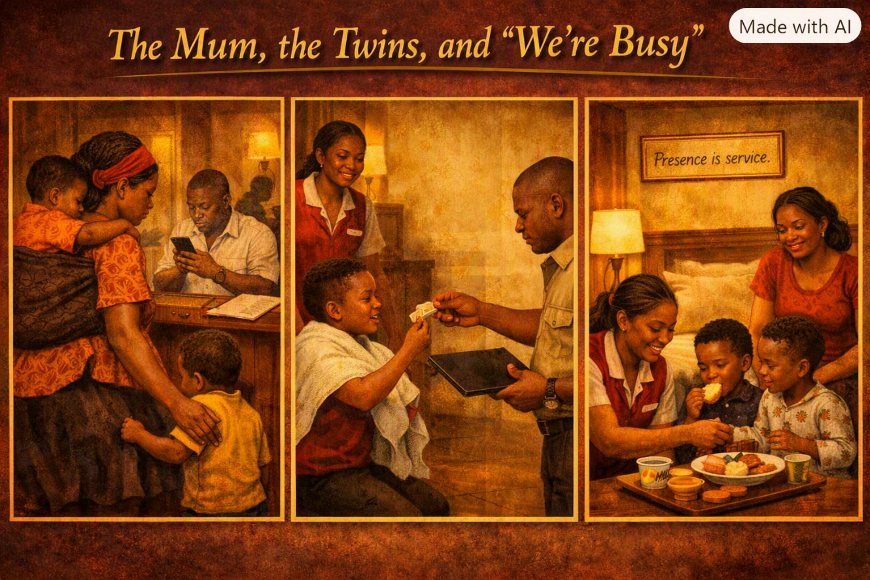
Upon reaching the hotel, she lifted the sleeping twin onto her back and the other, limp with tired sleep dragging her skirt, she held by the hand.
The booking promised “Family Room, Sea View.” The sea was dark. The children were simply exhausted.
At the reception desk, she placed the booking on the counter. “Please, is the room ready? The boys haven’t eaten.” (sounding frustrated)
The front desk officer did not look up from his screen. “Madam, we’re busy. Check-in will take time.”
Ama shifted the child on her back. “Please, just the key. I can fill the form later.”
“We have procedure,” he said. “Wait small.”
The sleeping twin woke and started crying. The other sat on the floor. A towel slipped from Ama’s bag.
Behind the counter, two other staff scrolled their phones. This is where hotels lose mothers. Not because the room is bad, but because the first three minutes say, you are a problem.
Ama’s eyes filled, not with tears, but with that hot, quiet anger every parent knows. “I’ve been traveling with two children since morning. You are busy. I am tired.”
The officer shrugged. “Madam, everybody is tired.”
A guest in the lobby looked away. A cleaner with a mop paused. If nothing changed now, the review would write itself: “Rude staff. Don’t go with children.”
The housekeeper was nineteen. Her name tag said Abena. She was not on duty at reception. She was passing with fresh towels. She saw the boy on the floor. She saw the mum’s hands shaking. She hesitated. Training said wait. Her heart said move.
She did three things, fast.
First, she became human before she became staff. She knelt. “Master, come.” She took the boy’s hand and gave him a folded towel like a cape. “You are Superman. Let’s find your bed.”
Second, she bypassed procedure to serve the person. She looked at the front desk officer. “Boss, give me the key. I’ll do the form for her in the room.” He hesitated. She held out her hand until he dropped the key into it.
Third, she met the basic needs. “Madam, hot water will be there in two minutes. I’ll bring extra towels, soap, and bread and Milo for the boys. On the house.”
She did not ask permission for kindness. She would ask for forgiveness later.
Room 204 was not perfect, but it was ready. Abena turned on the heater, laid the towels, poured water, and sat on the floor to help one twin eat bread. Ama cried then, quietly. “Nobody has spoken to me like a person since morning.”
Abena shrugged. “My mother also traveled with us. I remember.”
At 11:30 p.m., the boys were asleep. Ama sat on the bed and texted her sister: We are safe. There is an angel here.
Ama checked out at 7:00 a.m. She did not ask for a discount. She asked for Abena’s supervisor. She wrote in the guest book, not the complaint book: Your front desk was busy. Your housekeeper was present. I will bring my church group here because of her.
The GM walked through the lobby later and noticed the towel Abena had used, folded neatly on the counter. He touched it and thought: service begins with seeing.
That same day he called a staff meeting. Not to punish the front desk officer, but to re-train. A new rule went on the wall: No guest is ever “too busy” for. If your hands are full, your mouth must still be kind. Find help.
Abena was moved to front desk training the next month.
The lessons? Never be too busy to respond. Willingness to help is a standard, not a mood. Procedure should serve people, not block them. Politeness and presence win first. A smile, a kneel, eye contact. Guests remember how you made them feel before they remember the room number. Respond to the human need first. Towels, hot water, food for children. Small acts remove big stress.
Ama came for a bed. She left with dignity.
And Cape Coast got a hotel that learned: being busy is never an excuse for not being present
Disclaimer
The Fifth Key is a fictionalized case study. While inspired by real challenges in Ghanaian hospitality, the characters, properties, and scenarios are imagined. Any resemblance to actual people or establishments is coincidental. The purpose is to share operational lessons through storytelling, not to name, shame, or critique any individual or business.