
At 2:30 p.m., he stood up. “Cancel my booking. I’m going to a different hotel.”
His name was Yao. Contractor. Not a tourist. He had driven from Accra, dusty, with a meeting at 3:30 p.m. He had paid for early check-in at 2:00 p.m. so he could shower and change.
At 2:00 p.m., the room was not ready. At 2:15 p.m., Front Office said, “Small time, uncle. Cleaning.” At 2:30 p.m., he was done.
This is how hotels lose money without knowing it. Not because the room is dirty. Because time was disrespected. One guest becomes ten contractors. Ten contractors become fifty room nights. And one Google review that says “They don’t keep time” lives forever.
The GM was at the back office counting linen. She heard the argument. She came out. No heels, no big English. Just three things, fast.
First, she owned the minutes. No jokes about “Ghana man-time.” No excuses. She looked at her watch and said, “Uncle, you are right. You paid for 2:00 p.m. It is 2:31 p.m. We failed you by 31 minutes.” When you own the exact minutes, the guest stops fighting. He feels respected.
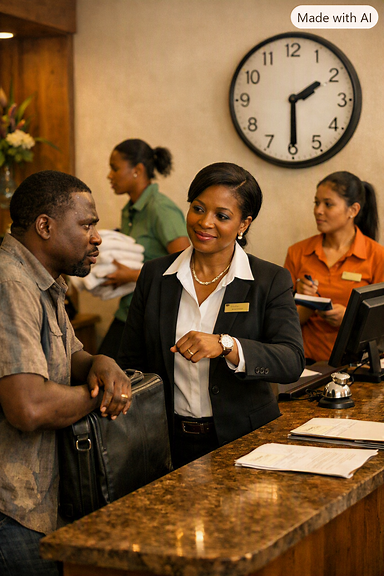
Second, she solved with urgency, not sympathy. Sympathy is “Sorry ooo, uncle, please.” Urgency is movement. She pressed her radio: “Head housekeeper, drop everything. Room 12 now. I’m coming with you.” She entered the room herself, checked corners, bed, bathroom, AC remote. Seven minutes. She stripped one pillowcase with her own hands. When the boss cleans, the team runs.
Third, she paid for the disrespect. She refunded the early check-in fee, offered lunch on the house, and promised his bag would be in the room before he returned from site. She handed him the key at 2:39 p.m. “2:00 p.m. means 2:00 p.m. Starting today.”
Yao stared. “You didn’t beg me to stay?” She smiled. “No, uncle. I made staying make sense.”
He made his 3:30 p.m. meeting. He came back at 6:00 p.m. His bag was in the room. Cold water in the fridge. AC already on. A handwritten note on the bed: “Sorry again for 31 minutes. — GM.” He did not cancel his two-night stay. He extended to four. Because she respected his clock.
On Monday, she wrote one line on the board in red marker: “2:00 p.m. = 2:00 p.m. Not 2:30. Not ‘soon’.” Then she changed three small things that cost almost nothing. No early check-in sold unless the room is ready. All front desk clocks synced to phone time. And a ladder for compensation: apology + water for 0–14 minutes, snack + supervisor apology for 15–29, refund + lunch for 30+. Staff had power to act without waiting for GM.
She even changed the staff shirts. From “Relax, this is Ghana” to “On Time, On Duty.”
The lesson is simple. Guests don’t buy a bed. They buy a promise. Time is not African or European. Time is an amenity. Like soap, towel, Wi-Fi. When you sell 2:00 p.m. check-in, you sell trust. Late delivery is a broken product.
So, stop hiding behind culture. “Ghana man-time” is not a service standard. It is an excuse. Professional hotels set their own clock, and guests set their watches by it. And when you break time, repair it with value, not grammar. Don’t say “We sincerely apologize for any inconvenience caused.” That English does not return 31 minutes. Return money, return food, return action.
Yao came for a room. He left with respect for a clock. And Ho got a hotel that learned the most expensive thing in hospitality is not linen. It is minutes.
The Fifth Key Lessons:
This story is not about a dirty room. It’s about a broken promise. The Fifth Key is Reliability = Keeping Promises.
1. Time is an Amenity, not a Favour
When Yao paid for 2:00 p.m. early check-in, he didn’t buy a bed. He bought time to shower before his 3:30 p.m. meeting. Like soap, towel, and Wi-Fi, time is part of the product. If you sell it and don’t deliver it, you delivered a broken product.
Practical rule: Don’t take money for a time you haven’t prepared for. If the room is not ready, don’t sell early check-in. Offer a holding lounge with AC, shower and coffee instead.
2. Don’t Hide Behind Culture — Set Your Own Clock
“Small time, uncle” and “Ghana time” are not service standards. They are excuses. A professional hotel sets its own clock and guests set their watches by it.
Practical rule: Sync all front desk clocks to phone time. Log lateness in exact minutes — 7 mins, 18 mins, 31 mins. What you measure, you improve. When you own the exact minutes — “We failed you by 31 minutes” — the guest stops fighting.
3. Solve With Urgency, Not Sympathy
Sympathy is “Sorry ooo uncle, please.” Urgency is movement. The GM pressing the radio and stripping a pillowcase herself showed urgency. When the boss cleans, the team runs.
Practical rule: Show, don’t just say. Go with Housekeeping. Check the room yourself. Make the guest see movement, not just hear apology.
Disclaimer
The Fifth Key is a fictionalized case study. While inspired by real challenges in Ghanaian hospitality, the characters, properties, and scenarios are imagined. Any resemblance to actual people or establishments is coincidental. The purpose is to share operational lessons through storytelling, not to name, shame, or critique any individual or business.