
The lanterns on the shelf behind Esi glowed steady, charged and ready for whatever came next. Beyond the glass doors, Accra pulsed with its restless rhythm; inside Parkens, the lobby was calm. Guests checked in softly, staff moved with confidence, and the place carried the steady breath of a hotel that had learned to survive storms.
The archive binders in the back room were full now. Their pages held night audit errors, guest feedback, generator logs, and the notes students scribbled in the margins during training. They had been argued over in classrooms, cited in lectures, and borrowed by managers from Dakar to Nairobi. What began as one hotel’s mistakes had become a shared classroom.
Esi ran her thumb along the brass bell at reception. Two years ago, that bell made her flinch. She was “Trainee Esi” then, from HOTCATT, carrying more fear than files. The First Crisis had nearly broken her — a blackout during check‑in, a guest shouting, a logbook she could not hide.
Her mentor came to stand beside her. He did not look at the screen. He looked at her. His voice was low, the way it was when he taught without a lesson plan. “You’ve crossed the line, Esi. You’re not the trainee anymore. You’re the manager who steadies the room.”
She thought of that blackout log. The red ink. The critiques that stung at the time and later became curriculum. She thought of the students who had sat in this same lobby, pointing at her errors until the errors turned into lessons they could use. She thought of the lanterns — symbols of readiness, of light carried forward when the grid failed.
Leadership, she was learning, was not about being flawless on paper. It was about being present in the room. About becoming the face people trusted when the lights went out.
Later that night, after the last check‑in, she walked the hotel the way Madam Abena taught her. Slow. Low. She stopped at the kitchen pass to thank the dishwasher by name. She checked on the new HOTCATT intern at the POS. The girl’s hands were shaking. Esi did not take the mouse. She put her hand over the intern’s, guided one transaction, and stepped back. “You’ve got it. I’m right here.”
The intern exhaled. The lobby exhaled with her.
Two evenings later, Parkens opened the lobby for a small gathering. No press release. No ribbon. Faculty from CDI, HOTCATT, and GIMPA stood beside housekeeping, accounts, and bell staff. They came to dedicate the new Learning Wall — ten panels, each named for a lesson Parkens learned by doing. Service as rest. Teams mended. Integrity under pressure.
There were no speeches for applause. Only continuity.
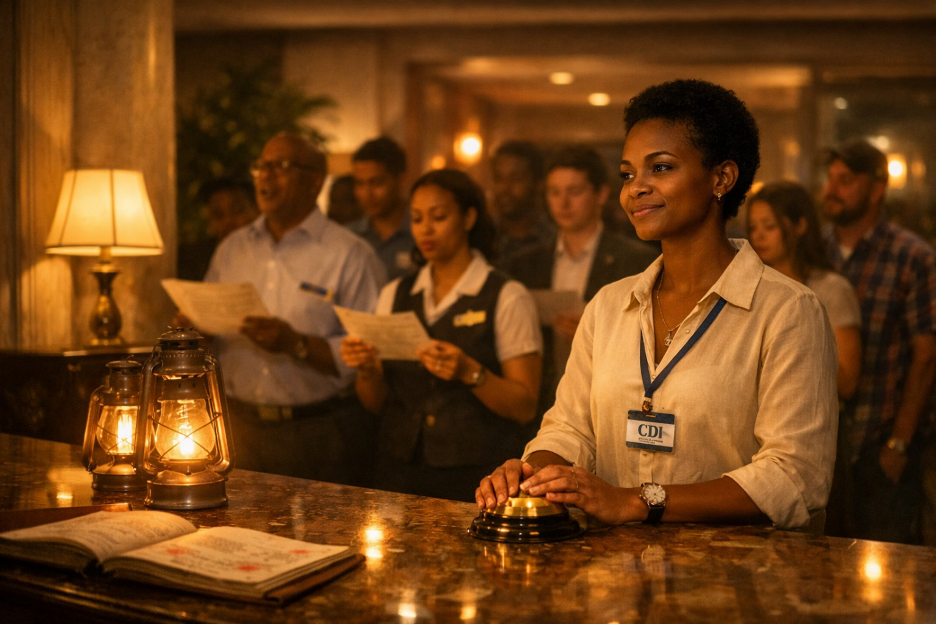
A hymn rose softly between the marble and the brass bell. It was an old one they sang after exams at HOTCATT. The words were simple: “We learn by living, we lead by serving, we remember by sharing.”
Voices joined one by one. Kojo from Accounts, who once told her front office was “too soft” for her. Auntie Lydia from Housekeeping, who first handed her a mop and later a key. The intern from that night, singing without shaking.
Esi kept her hands on the bell. She felt the ripple move outward — from her own crisis at Parkens, to a binder, to an archive, to a classroom that now stretched beyond one hotel. Hotels as living classrooms. Ghana to the region.
Closing Reflection
- The manager emerges not in silence, but in song.
- Legacy is not a binder on a shelf; it is a living voice carried forward.
- Hospitality becomes heritage when stories are shared, not hidden.
- The Fourth Key is not an ending. It is a torch, passed again and again.
Esi looked around — the marble floor, the brass bell, the lanterns glowing soft. Everything was the same. And yet, everything had changed.
Tomorrow would bring new guests, new tests, new lessons. There would be nights that tested her again. But the archive would grow. The interns would return as managers. The hymn would be sung in other lobbies.
Tonight, she knew: The manager had finally emerged.
Disclaimer
The Fourth Key is a fictionalized narrative. It draws on real industry contexts but tells its story through imagined characters and scenarios. Any resemblance to actual people or events is coincidental. The purpose is to share operational insight through storytelling, not to critique individuals or institutions.