
The induction week began with good intentions.
Hospitality Associates had designed a two-track orientation: one for lodge staff, one for park rangers. The goal was mutual understanding. A day was even set aside for selected supervisory personnel at the lodge to place themselves in the ‘shoes’ of the rangers. The result, however, was mutual suspicion.
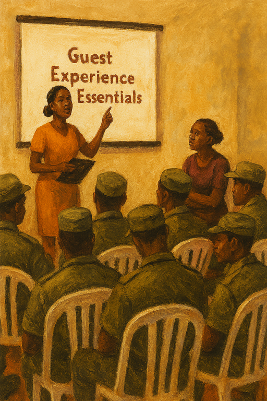
Inside the lodge, rangers sat stiffly in plastic chairs as a young trainer from Accra lead a discussion on “Guest Experience Essentials.” She spoke of eye contact and the importance of smiling—even when tired.
Musah whispered to Adiza, “We smile when we see elephants. Not when tourists make unnecessary demands.” Johnson stifled a laugh. The trainer continued.
Meanwhile, selected newly employed supervisors, together with Yawa-Attah, were sent into the field, where they were met with skepticism by the rangers. Yawa-Attah led the supervisory team to the salt lick trail, guided by Ranger Alhassan, who seemed to be watching them with a mixture of amusement and disdain.
They wore boots borrowed from the storeroom and carried water bottles like tourists, earning a raised eyebrow from Alhassan. As he explained the signs—hoof prints, broken branches, dung piles—Aanani stepped too close to a termite mound and was gently pulled back.
“You don’t walk ahead of the ranger,” Alhassan said, his voice low and even. “You follow the rhythm of the land.”
The supervisors nodded, but it was clear they were just going through the motions. The tension simmered, waiting to boil over.
Late that afternoon, a tourist vehicle returning from a game drive hit a pothole near the eastern boundary. The axle snapped. The vehicle tilted dangerously, with two guests still inside.
The driver radioed for help. The lodge manager on duty panicked. He sent a housekeeper with a first aid kit and tried calling the park office. No one picked up.
Musah heard the call on his ranger radio. He didn’t wait. He grabbed a toolkit, flagged down Adiza, and sped off on a motorbike.
By the time they arrived, the guests were shaken but unharmed. Musah assessed the damage, his movements swift and efficient. Adiza calmed the tourists, her voice soothing. The housekeeper stood awkwardly, unsure what to do.
Minutes later, Mr. Aanani arrived in a pickup truck with a supervisor. For a moment, it was unclear what would happen next. Would the lodge personnel try to take control, or would they trust the rangers to handle the situation?
For a short while, Mr. Aanani didn’t interrupt. Then something shifted. He joined the effort, his movements fluid and coordinated. Together with Musah and the driver, they lifted the vehicle, stabilized the axle, and drove the guests back to the lodge.
That evening, no one spoke of termite mounds. They spoke of trust.
Yawa-Attah called for an open debrief. No printed agenda. No projector. Her voice allowed the room to breathe.
Alhassan spoke first, his words like a slow-burning fire.
“We know the land. You know the lodge. We both know the guests.”
Musah added, his voice a low rumble.
“Show us how different you want us to welcome with warmth. But let us show you how we walk with wisdom in the park.”
Aanani nodded. “We need both.”
The air thick with unspoken questions; there was tension. Would they be able to bridge the gap, or would the divide between rangers and the new management of the lodge prove too great to overcome? The answer, for now, was uncertain.
Disclaimer
This story is a work of fiction inspired by the operational experiences and sectoral engagements of Hospitality Associates and its collaborators. While the narrative draws upon real industry contexts, any resemblance to actual persons, living or dead, or real-life events is purely coincidental. Characters, locations, and scenarios have been fictionalized or amalgamated to serve educational and storytelling purposes. The intent is not to critique individuals or institutions, but to distill operational insight through dramatic narrative.