
The two-year secondment contract ended, and the shareholders made a quiet decision: they would not let him go. He was no longer seconded. He was theirs. The lodge offered him full employment as substantive manager—not because he dazzled, but because he endured. He had become the quiet hero of HA’s Second Key.
Under his leadership:
• Staff turnover dropped.
• Guest satisfaction rose.
• Wildlife patrols stayed consistent.
• Revenue-sharing remained fair and transparent.
He never claimed credit. He simply kept the lodge alive—its evenings warm, its systems honest, its people seen.
Two years passed, and the manager from Hospitality Associates, Sylvanus Quarm, once a quiet presence in the boardroom, had become the steady heartbeat of Savannah Lodge. His name was not etched in bold headlines, but in the daily rhythms of the lodge—where books balanced, wildlife rules held, and evening lanterns never failed to glow. He was practical. Humble. Rooted in both numbers and people. He walked the grounds with rangers, listened to the hotel’s staff, and sat with guests beneath the Quiet Zone’s canopy. He did not chase innovation for its own sake. He repaired trust. He sustained what mattered. Where others saw fractures, he saw opportunities for quiet repair.
The lodge had seen its share of conflict. Rangers once felt displaced when new locks barred them from supply rooms they had freely entered for years. They bristled at losing the poolside evenings they considered theirs, and at being moved from the viewing platform that became a premium guest zone. They resisted the shift from oral huddles to printed briefings, seeing them as a waste of field time. They struggled when asked to prioritize guest comfort over their own quarters in the generator and water allocations. He had seen it all.
And under his leadership, these tensions softened by Hospitality Associates were sustained—not through force, but through the art of corporate politics.
• Strategic Silence and Timing: He never confronted resistance in public. When rangers protested their exclusion from the Quiet Zone, he let tempers cool before quietly inviting them back—not as guests, but as hosts who welcomed visitors to the waterholes. He understood that silence, followed by carefully chosen timing, could turn resentment into pride.
• Shared Ownership of Wins: When guest satisfaction rose, he credited the rangers’ patrols. When revenue-sharing remained fair, he praised the accountants. When tourists embraced infographics, he highlighted the rangers’ adaptability. Success was never his alone; he spread it so widely that every stakeholder felt part of the lodge’s triumph.
• Rituals of Belonging: He kept the lantern-lighting ceremony every evening, insisting it was not just ambiance but a symbol of continuity. Shareholders saw stability, rangers saw tradition, and guests saw magic. At quarterly reviews, there was transparency. And when the ledger was closed, it was done in the presence of both shareholders and rangers, a practice that reminded everyone that stewardship was a shared responsibility.
• Quiet Diplomacy: He often met stakeholders individually, tailoring his tone: practical with shareholders, empathetic with rangers, visionary with guests. He spoke of “our lodge,” “our waterholes,” “our lanterns,” dissolving divisions with language that bound everyone to a common legacy.
It has been 28 years now, and he is retiring.
Guests gathered in the Quiet Zone. Rangers stood beside hotel staff. Shareholders came, not with speeches, but with gratitude. Adiza whispered, “He never raised his voice. But he raised all of us.” Musah added, “He didn’t just manage the lodge. He belonged to it.”
There were no grand innovations to celebrate. Only steady stewardship. Only legacy.
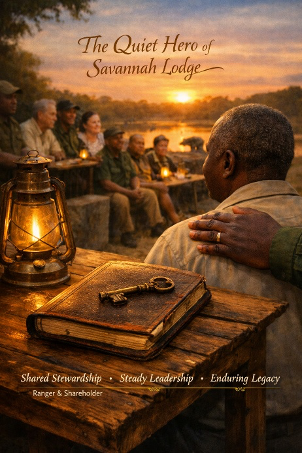
As the lanterns flickered and the sun dipped low, a final image remained:
A well-worn ledger closed gently. A ranger’s hand on the manager’s shoulder. A path lit for the next to walk.
Contracts expire. But people carry the legacy forward.
This ends our narration on The Second Key. The Third Key will open upon the private sector, exploring how contract management could shape hotel operations—and where new lessons of stewardship and legacy await.
Disclaimer
This story is a work of fiction inspired by the operational experiences and sectoral engagements of Hospitality Associates and its collaborators. While the narrative draws upon real industry contexts, any resemblance to actual persons, living or dead, or real-life events is purely coincidental. Characters, locations, and scenarios have been fictionalized or amalgamated to serve educational and storytelling purposes. The intent is not to critique individuals or institutions, but to distill operational insight through dramatic narrative.