
Introductory Remarks
The journey through the Keys has already shown us contracts tested, resisted, and reshaped. Each model revealed both promise and limitation, but none fully answered the deeper question: could hotel management be more than agreements on paper? The Third Key left us with lessons of pragmatism and investor realities, yet the search for a model that could raise leaders, not just revenue, continued.
If you thought the ‘Keys’ were only about contracts, think again. The next series takes us beyond agreements and into transformation. The 4th Key is not about outsourcing management — it is about insourcing the future. Welcome to Parkens Hotel, where the classroom itself checked in.
Prologue
What happens when hotel management becomes a classroom, and students become leaders?
In Ghana’s shifting hospitality landscape, Hospitality Associates had tested various models. Some brought structure. Others brought profit. A few brought accountability. But none answered the deeper question: What if a hotel could raise leaders, not just revenue?
The industry stood at a crossroads. Owners were tired of revolving‑door managers and systems that collapsed when the consultant left. Students were tired of graduating with certificates but no confidence. Communities were tired of hotels that felt imported, not rooted. Everyone was asking for something the old contracts couldn’t deliver.
So, Hospitality Associates ‘tore up’ the template.
Instead of sending managers to run hotels, they sent classrooms. Instead of signing contracts to extract profit, they signed agreements to implant purpose. Through CDI, their training arm, students would step out of lecture halls and into lobbies. Hotels would stop being just assets. They would become living laboratories where American curriculum met Ghanaian reality, where owners gained systems and students gained scars, where education, transformation, and legacy finally shared the same bed.
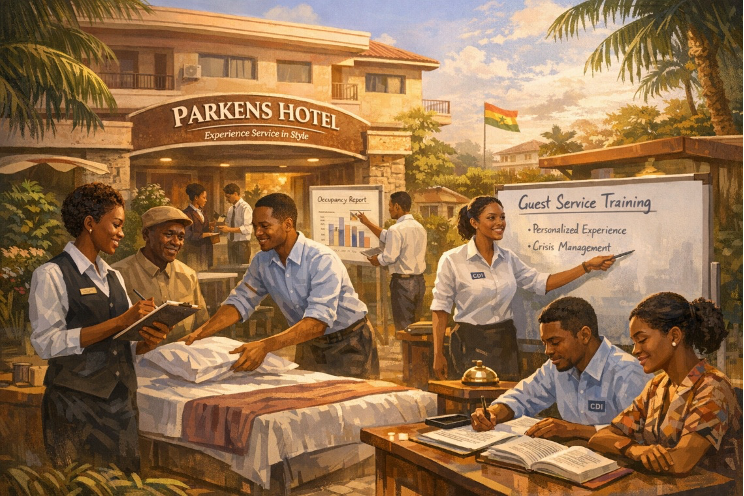
Students from CDI would report for duty, not just for lectures. Front desks would become exam halls. Night audits would become case studies. The hotel would stop hosting only guests. It would host learning. In that sense, the classroom itself was checking in — uniforms, textbooks, and all.
For Esi, a second‑year CDI student, it was not a metaphor or a case study. It was her name on a roster taped to a duty manager’s door. She was 22, armed with SOPs and terrified of failing. She stood at the gates of Parkens Hotel — seven tired flats in East Legon with a leaking roof and a slogan it hadn’t earned yet: “Experience service in style.” The scent of fried plantain from a nearby stall drifted through the gate, mingling with the damp air of Accra’s rainy season.
The gate was open. The test was live. Could a leaking roof and weary staff become the birthplace of a new model for hospitality? For Esi, it was more than a question. It was the beginning of a story of resistance, struggle, and transformation.
Disclaimer
The Fourth Key is a fictionalized narrative. It draws on real industry contexts but tells its story through imagined characters and scenarios. Any resemblance to actual people or events is coincidental. The purpose is to share operational insight through storytelling, not to critique individuals or institutions.