
On 22 June 2006, Hibiscus Hotel in Accra entered into a hurried Memorandum of Understanding with Hospitality Associates (HA). The hotel’s manager was departing the country, and the non‑resident owners—on a brief visit to Ghana—sought assurance that the facility would not drift into decline. Mr. Ofori, introduced as their representative, signed on their behalf.
The clauses of the MOU were bold. HA would operate the hotel as a two‑star facility, install a resident manager, supervise all staff, and overhaul systems and procedures. Recruitment, training, discharge, and supervision of personnel would be HA’s exclusive right. Operational accounts would be opened with HA as signatories, and a 10% commission on gross revenue would be paid monthly.
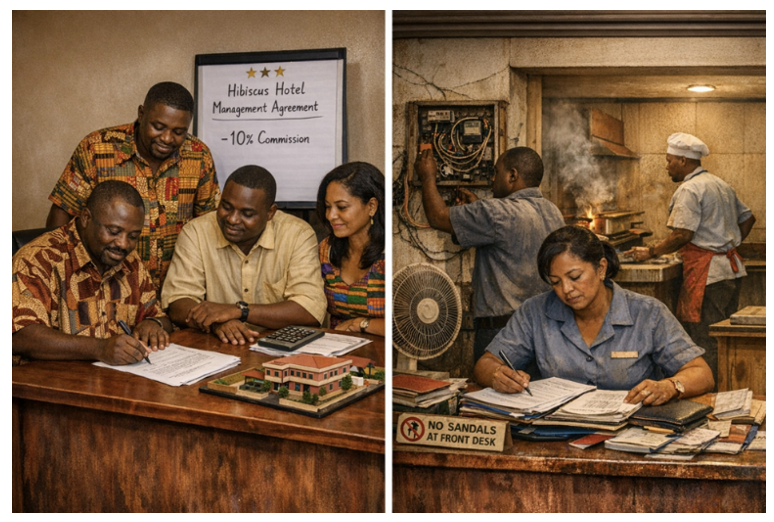
For the owners, this was a leap of faith. They relinquished all operational duties, trusting that HA’s systems would deliver recognition, star ratings, and profitability. For HA, it was an opportunity to prove that structure could transform a family‑led enterprise into a professional hotel.
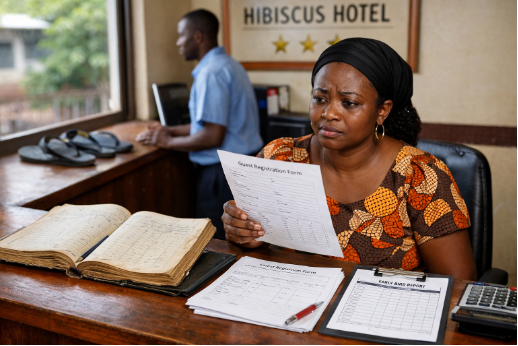
Yet reality intruded almost immediately. Receptionists, long reliant on two handwritten ledgers, balked at the introduction of administrative forms designed to capture incomes, audit sales summaries, and to prepare “Early Bird” reports showing daily room status and departmental incomes. Without computerized systems, the paperwork felt overwhelming.
Training sessions were held in small groups, but attitudes proved harder to change. Mr. Adams, the newly appointed resident manager, issued queries that revealed the clash between informal habits and professional expectations. One staff member was reprimanded for spreading sandals in the sun at the front desk, another dismissed for ignoring a query on night audit reports, and a kitchen worker queried for leaving fish exposed after closing early. These letters showed HA’s determination to enforce discipline—uniforms, punctuality, reporting lines—but also highlighted the fragility of staff morale. Some employees resigned without notice, creating instability just when HA needed continuity.
The following week revealed deeper cracks—not only in staff morale, but in the very fabric of the hotel itself. Guests complained of air conditioners that rattled through the night, taps that ran dry, and ovens that failed mid‑service. Linen supplies were irregular, toiletries inconsistent, and repairs slow.
Mr. Adams’, the resident manager, report painted a stark picture: parquet floors worn, bathrooms and fittings failing, furniture outdated, electrical wiring dangerous, plumbing unreliable. A recommendation from an engineering company was clear—complete re‑wiring, proper earthing, and a full makeover of rooms and the administrative building.
Yet the operational account, meant to provide four months of working capital, was reduced to two. More critically, the funds were never intended for the kind of structural overhaul the facility demanded—an issue never discussed with the owners. HA’s systems demanded reliability, but the tools at hand were fragile.
As months passed, the promised Board never materialized. HA found itself reporting to one man. Decisions that should have been collective became personal. Requests for funds stalled when Mr. Ofori was unavailable or hesitant. Owners abroad began to question whether his reports truly reflected HA’s operations. Suspicion grew—was HA overstepping, or was Mr. Ofori shielding the owners from uncomfortable truths?
The probationary period, set for six months, never reached its full course. After only four months of operation, the MOU was suddenly abrogated. For HA, this was a bitter disappointment. They had pressed for discipline and systems, determined to make a positive impact, but staff resisted, clinging to familiar ways. Owners, distant and disengaged, failed to provide the governance structure that could anchor the partnership. What began as ambition soon felt like imposition.
The abrupt termination left HA frustrated—not out of malice but out of misalignment. The ambitious owner’s dream of professional oversight faltered against the realities of distance, fragile systems, and cultural resistance. For HA, it was a sobering lesson: contracts signed in urgency and optimism must be backed by structure, commitment, and trust.
Closing Reflection
The Hibiscus Hotel episode reminds us that ambition alone cannot sustain transformation. Systems, discipline, and contracts may set the stage, but without cultural alignment, reliable infrastructure, and governance rooted in trust, even the most carefully drafted agreements unravel. Distance magnifies fragility, and urgency often blinds partners to the deeper foundations required for success.
Disclaimer
The Third Key is a fictionalized narrative. It draws on real industry contexts but tells its story through imagined characters and scenarios. Any resemblance to actual people or events is coincidental. The purpose is to share operational insight through storytelling, not to critique individuals or institutions.