
The air after induction week was heavy with questions. The rangers had proven their worth in crisis, but the new management of the lodge still clung to procedure. Each morning, the baobab tree huddle continued—quick, oral, efficient. Yet near the front desk, the supervisors insisted on their scheduled briefing, printed sheets stacked neatly, charts and tables waiting for signatures.
The paper smelled faintly of ink and dust. Outside, the baobab leaves whispered in the wind, while tourists’ chatter drifted through the open lounge.
The rangers saw the sheets as a waste of field time.
“We already know what’s happening,” Adiza muttered one morning, glancing at the paper. “We live it.”
Musah folded his arms, refusing to sign.
The supervisors frowned but said nothing. One finally murmured, “Without signatures, the lodge risks audit penalties. The contract requires compliance.”
For weeks, the divide lingered. Oral versus written. Informal versus procedural. The lodge seemed split in two rhythms.
Then, unexpectedly, a bridge appeared.
It began when Mr. Aanani quietly approached a ranger whose sketch of a bateleur eagle had once hung unnoticed near the ranger quarters.
“Could you help me design something for the guests?” he asked, voice low. “Something they can see before they ask.”
The ranger nodded.
A week later, a laminated infographic appeared near the guest lounge. Bright colors, simple icons, and short captions explained the elephant migration routes. Tourists gathered around, pointing, asking sharper questions.
Soon another appeared: “How to Spot a Bateleur Eagle.” Then “Why Antelopes Freeze Before They Flee.”
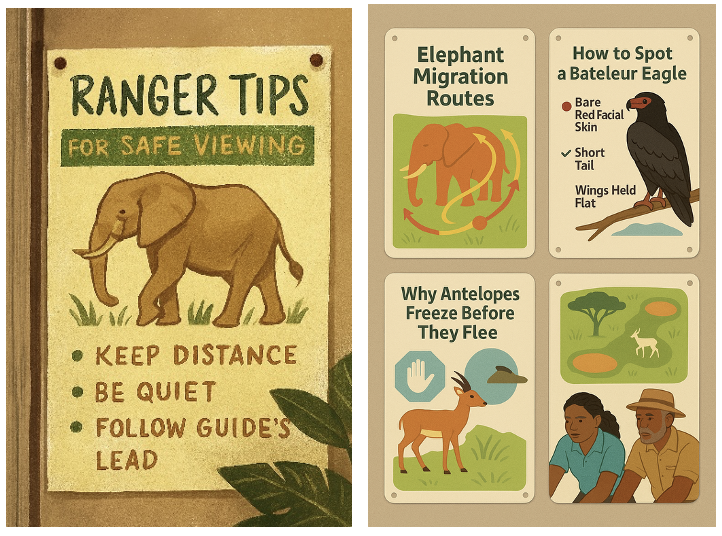
The rangers noticed something. Tourists stopped asking long, repetitive questions. They engaged faster. They understood more.
“This is better,” Musah admitted quietly. “They see before we even speak.”
Infographics—visual representations combining data, text, and images—had become a bridge. Oral knowledge translated into written color; procedure softened into story.
Mr. Aanani reflected: “It is not just for guests. It is for us—to prove that our voices can live on paper without losing their spirit.”
The rangers, once skeptical of printed materials, now embraced them as tools for storytelling and pride. Not for internal briefings, but for engaging tourists.
Yawa-Attah saw the shift. She didn’t push the morning sheets anymore. Instead, she invited rangers to contribute to the infographic wall. Each week, a new theme. Each week, a ranger’s voice translated into color and shape.
One morning, Adiza arrived early. She didn’t join the baobab tree huddle. She stood by the front desk, reviewing the briefing sheet. Then she walked to the infographic board and adjusted the placement of a new poster: “Ranger Tips for Safe Viewing.”
She turned to Yawa-Attah.
“We still prefer to talk. But this helps them listen.”
Yawa-Attah smiled.
“Then let’s keep both.”
Outside, the sun climbed higher. The baobab tree cast its shadow. And inside Savannah Lodge, voices and visuals began to share the same space—oral rhythms and written colors crossing into one another, a bridge built not of stone but of story.
Disclaimer
This story is a work of fiction inspired by the operational experiences and sectoral engagements of Hospitality Associates and its collaborators. While the narrative draws upon real industry contexts, any resemblance to actual persons, living or dead, or real-life events is purely coincidental. Characters, locations, and scenarios have been fictionalized or amalgamated to serve educational and storytelling purposes. The intent is not to critique individuals or institutions, but to distill operational insight through dramatic narrative.